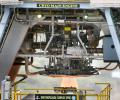
The Indian Space Research Organisation (ISRO) on Saturday said it has successfully conducted the flight acceptance hot testing of the cryogenic engine identified for the sixth operational mission of LVM3 launch vehicle (LVM-M6) at ISRO Propulsion Complex, Mahendragiri in Tamil Nadu.
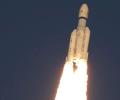
Indian Space Research Organisation scientists have carried out a new experiment on the indigenously developed C25 cryogenic stage of the LVM3-M5 rocket which successfully placed the Communication Satellite CMS-03 into the intended orbit on Sunday, said its Chairman V Narayanan.

Rajeev Srinivasan on the disastrous after-effects of a made-up spying incident
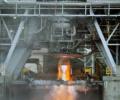
India's first indigenously designed and developed high-thrust cryogenic rocket engine generating a nominal thrust of 19 tonnes was successfully endurance hot-tested for 800 seconds.

While India's interplanetary ambitions remain significant, the current pace of financial and technical progress raises questions about whether the 2027-2028 timelines can be met.
K Radhakrishnan, chairman of the Indian Space Research Organisation, has said that India is preparing to launch its second moon mission Chandrayaan-II by 2013. "The Chandrayaan-II we are planning to have in the year 2013. By that time, we should have our GSLV (Geosynchronous Satellite Launch Vehicle) flying with the Indigenous Cryogenic Engine Stage. That is the target with which we are working," said Radhakrishnan.
The Indian Space Research Organisation successfully put India's heavy rocket Geosynchronous Satellite Launch Vehicle-Development 5 (GSLV-D5) into orbit from the spaceport at Sriharikota, Andhra Pradesh at 4.18 pm on Sunday.
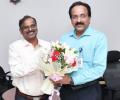
Narayanan has a long and distinguished career at ISRO, having played a key role in several important missions, including Chandrayaan-2 and 3, and the Gaganyaan programme.

Here's some exclusive, behind-the-scenes footage of the moon mission's various components coming together.
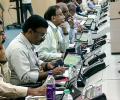
'The work is already on with various data being studied.'

The feat is the second one for the Indian Space Research Organisation scientists in using the indigenously made cryogenic stage after the January 5, 2014 launch of GSLV-D5.
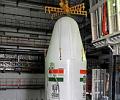
The launch of a Geosynchronous Satellite Launch Vehicle was called off by the Indian Space Reasearch Organisation at the eleventh hour on Monday due to a fuel leak in its second stage -- in a setback to the mission to test its homegrown cryogenic engine -- after its failure three years ago.

The satellite would provide a thrust to mobile communication through multi-beam coverage facility, the ISRO said.

For the first time in India, the facility enables 3D printing of aerospace and rocket components up to one metre in height.

'ISRO is resilient enough to spring back and come with a solution quickly.'
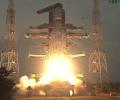
The heaviest communication satellite to be launched from the Indian soil onboard a new generation, homegrown 'Bahubali' rocket was successfully placed into the intended orbit on Sunday, the Indian Space Research Organisation said.

The rocket is almost 49 meters high -- as much as a 17-floor building. It weighs 415 tons -- as much as the combined weight of 80 full grown elephants.

Indian Space Research Organisation's second mission of the year to place an earth observation satellite by a GSLV rocket faced a setback as the mission could not be accomplished fully due to performance anomaly in the cryogenic stage of the rocket, the space agency said on Thursday.

It is important for India to develop multiple launch sites and become capable of undertaking more launches in a year's time, says Ajey Lele.
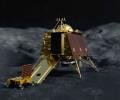
A number of private companies have contributed to the development of ISRO's Chandrayaan-3 spacecraft which successfully landed near the south pole of the Moon on Wednesday evening.

India's heavy-lift rocket GSLV MkIII, carrying communication satellite GSAT-19.

An industrial house bred in old-school manufacturing values, Godrej & Boyce has displayed unusual agility to become a trusted builder of advanced weaponry, discovers Ajai Shukla.
"First orbit raising operation of GSAT-6 was successfully completed by firing the Apogee Motor for 3385 seconds at 8:35 pm IST on August 28," the ISRO said.

Except Pakistan, seven SAARC countries are a part of the project.

A key feature of the satellite is providing mobile communication to India through multi beam coverage facility.

"Efforts are underway to establish the link with the satellite," it added.

And the first Indian to go into space from 'Indian soil' could well be a woman.

The mission life of the 2,250kg GSAT-7A, built by ISRO, is eight years. It will provide communication capability to users in Ku-band over the Indian region.

ISRO launched 12 Indian, 22 foreign satellites and successfully flight-tested India's first winged-body aerospace vehicle.

The ISRO lost communication with the satellite when it attempted to ignite the engine in a third and final move to its desired location.
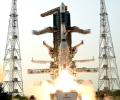
Over 32 missions -- satellites and rockets -- have been planned for the year.
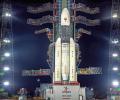
Late on Monday night, in a last-minute revision of schedule, ISRO announced that the launch of India's second lunar mission 'Chandrayaan-2' has been called off due to a technical snag.

Indian Space Research Organisation will announce a revised launch date later.
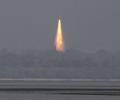
Enthused over its successful launch of GSLV D5 with GSAT-14 communication satellite from Satish Dhawan Space Centre in Sriharikota on Sunday, the Indian Space Research Organisation is planning a series of GSLV launches and an experimental launch of the advanced version GSLV Mark III soon from the spaceport.

The ISRO is aiming for a soft landing of the lander in the South Pole region of the moon where no country has gone so far.

Other than the Cartosat-2 series satellite, the PSLV is carrying 29 nano satellites from 14 countries - Austria, Belgium, Chile, Czech Republic, Finland, France, Germany, Italy, Japan, Latvia, Lithuania, Slovakia, the United Kingdom and the United States of America besides a nano satellite from India.

Billionaires are not only eyeing a profit as they push mankind out into the stars.
It appears India will be among those nations consigned to being among the watchers and not participants of this crucial phase, observes Aakar Patel.

The Rs 978 crore mission, which has been rescheduled for Monday after scientists corrected the glitch in the rocket, will be launched at 2.43 p.m from the second launchpad at Satish Dhawan Space Centre, over 100 km from Chennai.

'What we are trying for is to make space travel easier like air travel.' 'We have already established ourselves... the fact that other countries are coming to seek our help shows our technology is mature.'

It has already tasted success with the moon mission and Mangalyaan. Is man in space the next frontier for ISRO?
